One of the most important architects of modernism
Although the son of a stonemason from Aachen in Germany never sat a formal final examination, he seemed born to be an architect. Familiar with construction from an early age through his father's business, he moved to Berlin in Germany at the age of 19, where he worked in the offices of Bruno Paul and Peter Behrens, two central figures of the reform movement.
Mies gained access to wealthy, educated circles, some of them collectors, who turned his attention to modern art. His first designs for skyscrapers were created in the early 1920s. After his marriage failed, he led the life of a bachelor who, as a modernist, renounced all "trivial ornament". Yet even with his revolutionary open floor plans – mostly for villas – he never abandoned the basic pattern of bourgeois living, which included separating the men's and women's areas and screening off the staff.
His furniture was created as a by-product of his buildings. Landmarks of design include his work for the Weissenhof Estate in Stuttgart in Germany (1927), a project he directed, his German Pavilion for the World Exhibition in Barcelona, Spain (1929), and the Villa Tugendhat in Brno in Moravia, Czech Republic (1930).
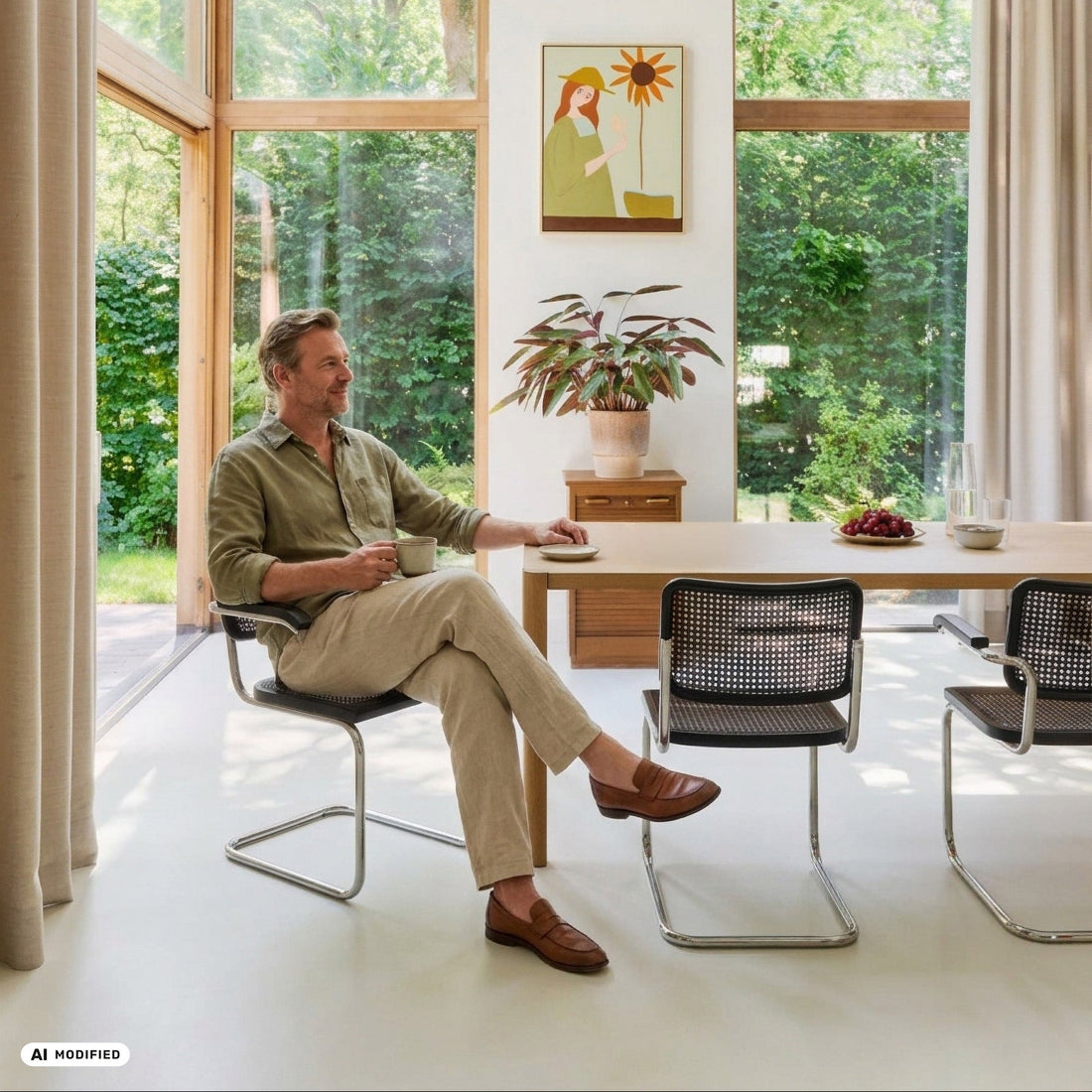
His international career began with the cantilever chair without back legs presented in Stuttgart, a concept by Mart Stam that he refined. He described the MR90 armchair for the World Exhibition as a "monumental object". The use of flat steel bar was unusual: relatively heavy, it made the formally convincing X-shaped frame possible. Although the furniture was initially produced only in small runs, it set new standards – as did the glass table with its visible cross-shaped base and the chaise longue with its parallel rolls. Its importance is shown not only by the number of copies and its eventual successful relaunch, but also by the way leading designers such as Franco Albini and Poul Kjærholm, as well as the anti-designers of Archizoom, took his ideas further.
Although Mies van der Rohe is usually associated with the Bauhaus, he had already developed all the essentials of his work before becoming its last director in 1930. His attempts to come to terms with the Nazi dictatorship failed. In the late 1930s, he emigrated to the USA, where he headed the architecture department at the Illinois Institute of Technology. Until his death, he worked as a sought-after architect all over the world and, alongside Marcel Breuer and Walter Gropius, was regarded as a grand master of the "International Style".