"I am a popular designer; people's homes are my museum. They have my toothbrushes and my chairs – why put them in a museum?"
Philippe Starck is one of the best-known designers of our time. It is hard to think of a place where you would not come across one of his creations. Alongside his many products, Philippe Starck himself often attracts public attention. Like his provocative, socially critical and self-critical statements, his designs are democratic in spirit.
The pop star of design
 Philippe Starck was born in Paris in 1949. Shortly after finishing his studies in the late 1960s, he attracted attention with a series of inflatable objects. He then spent two years as art director for fashion designer Pierre Cardin and began working on interior design projects for bars, discos and nightclubs.
In the late 1970s, Starck created his first furniture designs, including the Mac Gee shelf (1979), which is still made by the Italian company Cerruti Italia. Philippe Starck rose to prominence in the design world in the early 1980s, when he was commissioned by then French president François Mitterrand to design the interiors of the Élysée Palace in Paris. In 1984, he designed the prestigious Café Costes in Paris, where he created the now-famous three-legged Costes café chair, still made by Driade. 
Other well-known manufacturers later added original Philippe Starck designs to their ranges. Starck created products for all kinds of settings, from toothbrushes and pasta to motorbikes. In the late 1980s and early 1990s, he created a series of design icons, including the Juicy Salif lemon squeezer and Joe Cactus ashtray (both 1990) for Alessi, the Ará table lamp for Flos (1988) and the Lord Yo chair for Driade (1994).
Starck became known as the "pop star of design", not least because of the way he repeatedly put himself in the spotlight alongside his work. But it would be unfair to accuse him of giving little thought to his designs. Few designers explore the social and moral significance of design with the same humour and theatricality.
The values behind Philippe Starck's designs
 Starck's many creations can be considered in terms of both their cultural and emotional value and their economics. His Good Goods catalogues and his idea of "democratic design" aim to improve product quality, reduce prices and make distribution more accessible, so that design is available to everyone. These goals were also pursued by the Bauhaus, and Starck considers them largely achieved today.
Intangible ideas such as sex, sensuality and symbolism are just as important in Starck's designs as price and production conditions. He therefore likes to describe the Louis Ghost plastic chair, designed for Kartell in 2002, as "a kind of post-Freudian Bauhaus chair".
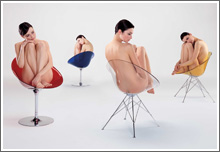
Today, Starck focuses on honest, enduring designs that aim to achieve a great deal with little effort. "My team and I try to take more and more material away from every object. We keep going until the computer says: no further, or the product will break. We don't make packaging that is only there to look pretty.".
Although he has hinted more than once at retiring, Starck has not given up his work. On the contrary, he is currently planning the interior of a Virgin Galactic spacecraft, which is due to take tourists into space soon.