Collections


Marimekko conquered the design world with bold colours and innovative shapes
 The Finnish textile company Marimekko was founded in Helsinki in 1951 by Armi and Viljo Ratia. The name, which literally means something like "Mari's dress", figuratively stands for "simple everyday clothing".
Yet Marimekko became famous for anything but simplicity. Above all, it was the bold designs, strong colours and innovative shapes of its textiles that brought the company its international breakthrough in the 1960s. Milestones in Marimekko's later history include the Unikko series created by Maija Isola and the Siirtolapuutarha collection by Maija Louekari and Sami Ruotsalainen, featuring the Oiva tableware.
Marimekko and its origins
Marimekko's origins go back to the textile company Printex, founded by Viljo Ratia in 1949 in response to the urgent need for clothing in the post-war years. Although Armi Ratia designed some patterns herself that sold well, she didn't see herself as a designer. So the young and ambitious Maija Isola joined Printex as its new head designer.
Marimekko's early years
 Marimekko was established in 1951 to market Printex's furnishing and clothing fabrics. When Marimekko presented its first collection in spring 1951 – fashion that was unusually cheerful and colourful for the time – the response was huge.
In 1953, Vuokko Eskolin-Nurmesniemi joined the design team and introduced a design policy of "anti-fashion". With bold cuts, simple fabrics and a progressive brand image, Eskolin-Nurmesniemi set trends rather than following them. By 1955, Marimekko had turned its finances around, and it gained an international reputation when it presented its products at the 1958 World's Fair in Brussels.
Swinging Sixties
 The Brussels World's Fair led to several export contracts, and Marimekko clothing made its way to America, where the then First Lady Jacqueline Kennedy bought seven dresses – giving the company strong international media coverage.
At the end of the 1950s, Vuokko Eskolin-Nurmesniemi left Marimekko and founded her own company, Vuokko Oy. Annika Rimala then took over as artistic director at Marimekko.
By using pure cotton instead of nylon, the new "wonder material" of the day, Marimekko clearly rejected the trend of the time and reinforced its image as an unconventional company. It was precisely this image – reflected in Annika Rimala's simple, chic and casual style of clothing and her bold, colourful fabrics – that made Marimekko so popular in the sixties, especially among women in creative professions.
Marimekko from the 1970s to today
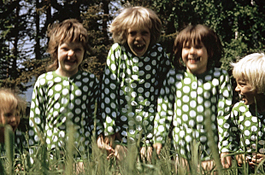 While the 1960s were inspired by space-age design and psychedelic colours, the 1970s saw a return to more serious and conventional designs. Rimala's Tasaraita collection from 1969 is a good example: the evenly striped clothing line included T-shirts, nightdresses, underwear and shirts, and was designed to complement the increasingly popular denim fashion. Despite – or perhaps because of – its sober simplicity, the series with its blue-and-white and red-and-white stripes became a real bestseller.
 Armi Ratia died in October 1979, and Marimekko was sold to the Amer Group in 1985. Although the founder's motto that "you have to be different" was still followed, the hoped-for commercial success failed to materialise. In 1991, Kirsti Paakkanen took over the struggling company and led Marimekko out of the red and into a new future.
Today, Marimekko designs and produces not only high-quality fashion, fabrics and bags, but also offers a wide range of ceramics, glassware and many other home furnishings for the bathroom, bedroom and living area. Marimekko cushions in particular recall the colourful clothing of earlier times. Alongside the legendary patterns by Maija Isola, Vuokko Eskolin-Nurmesniemi and Annika Rimala, Marimekko today presents many other designs by Finnish newcomers and leading designers such as Ilkka Suppanen, Nina Pirhonen and Harri Koskinen.
Over time, the successful Unikko, Pieni Unikko, Tasaraita and Siirtolapuutarha series – the latter featuring the Oiva tableware – have been joined by many other collections. As well as bold colour combinations, Marimekko also impresses time and again with strong, unmistakable black-and-white patterns – such as Räsymatto.